



Your one-stop solution to obtaining the NYS Infection Control certificate
Only $19.99
No travel or expensive books needed. Simple, quick, and effective online training!
Mandated training for dentists, dental hygienists, licensed practical nurses, optometrists, podiatrists, registered nurses, physicians, residents, physician assistants, specialist assistants, medical students, PA students, and nursing students in the State of New York
Satisfies your initial or repeat certification in the mandatory infection control and barrier precautions training as mandated by New York State. This course is the same as the one offered by your employer or hospital but can be completed entirely online on your own time and pace!
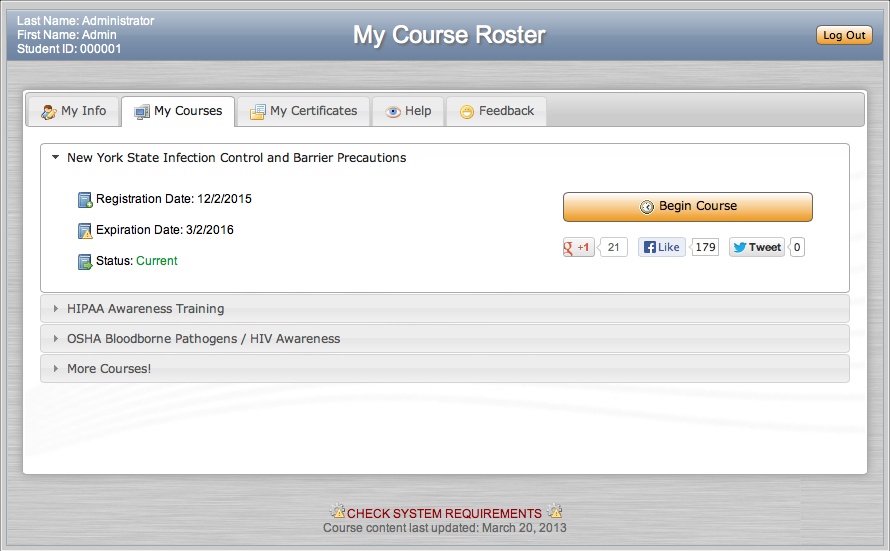
Covers the full NYSDOH infection control curriculum. Many students finish in under two hours, but course work does not need to be completed in a single session. You may log off at any time and return to the online course and quiz whenever you like. A downloadable PDF version of the course presentation for your eBook reader is also available
Now compatible with iPhone / iPad / Android devices!
30-day access to course materials and quiz, and unlimited access to your certificate thereafter
Awards a New York State Infection Control and Barrier Precautions certificate valid for 4 years, and available for immediate download / printing plus 24/7 access to your certificate for its entire validity
Free - direct electronic certificate submission to the NYSED
Free - unlimited certificate submission via fax to any number in the US!
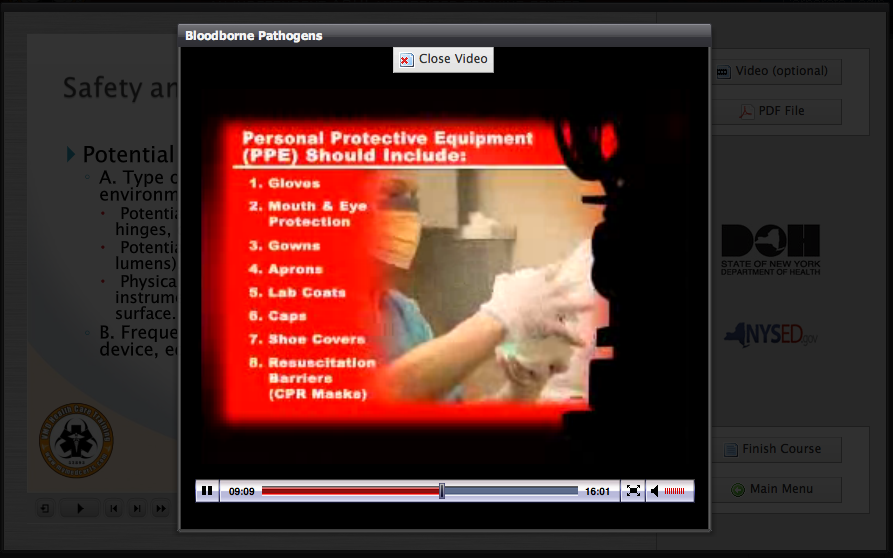
Free - optional bloodborne pathogens video segment
4 Contact Hours for continuing education credits
Who should take this course
In compliance with New York State Law: all dentists, dental hygienists, licensed practical nurses, optometrists, podiatrists, and registered nurses must complete course work or training appropriate to their practice regarding infection control and barrier precautions, including engineering and work controls to prevent the transmission of human immunodeficiency virus (HIV) and the hepatitis B virus (HBV) in the course of professional practice, every four years according to Section 6505-b of the Education Law. This training must be conducted by a provider approved by the State Education Department (NYSED). VMD Health Care Training is an approved provider: #IC161 (verify here).
All physicians, physician assistants, and specialist assistants must complete course work or training in accordance with Chapter 786 of the Laws of 1992 at the time of their initial licensure/registration and every four years thereafter. Furthermore, this rule now also applies to residents, medical students, and physician assistant students. This training must be conducted by a provider approved by the Department of Health (NYSDOH). VMD Health Care Training is an approved provider: #I02138 (verify here).
Course curriculum
In addition to the rules and regulations pertaining to professional conduct and presentation of current information, approved NYS Infection Control training must contain the six core elements of the NYSDOH infection control curriculum:
Element I
- Recognize the benefit to patients and healthcare workers of adhering to scientifically accepted principles and practices of infection prevention and control
- Recognize the professional's responsibility to adhere to scientifically accepted infection prevention and control practices in all healthcare settings and the consequences of failing to comply, and
- Recognize the professional's responsibility to monitor infection prevention and control practices of those medical and ancillary personnel for whom he or she is responsible and intervene as necessary to assure compliance and safety
Element II
- Describe how pathogenic organisms are spread in healthcare settings
- Identify the factors which influence the outcome of an exposure to pathogenic organisms in healthcare settings
- List strategies for preventing transmission of pathogenic organisms, and
- Describe how infection control concepts are applied in professional practice
Element III
- Define healthcare-associated disease transmission, engineering controls, safe injection practices, and work practice controls
- Describe specific high-risk practices and procedures that increase the opportunity for healthcare worker and patient exposure to potentially infectious material
- Describe specific measures to prevent transmission of bloodborne pathogens from patient to patient, healthcare worker to patient, and patient to healthcare worker via contaminated injection equipment
- Identify work practice controls designed to eliminate the transmission of bloodborne pathogens during use of sharp instruments (e.g., scalpel blades and their holders (if not disposable), lancets, lancet platforms/pens, puncture devices, needles, syringes, injections), and
- Identify where engineering or work practice controls can be utilized to prevent patient exposure to bloodborne pathogens
Element IV
- Describe the circumstances that require the use of barriers and personal protective equipment to prevent patient or healthcare worker contact with potentially infectious material, and
- Identify specific barriers or personal protective equipment for patient and healthcare worker protection from exposure to potentially infectious material
Element V
- Define cleaning, disinfection, and sterilization
- Differentiate between non critical, semi critical, and critical medical devices
- Describe the three levels of disinfection (i.e., low, intermediate, and high)
- Recognize the importance of the correct application of reprocessing methods for assuring the safety and integrity of patient care equipment in preventing transmission of bloodborne pathogens
- Recognize the professional's responsibility for maintaining a safe patient care environment in all healthcare settings, and
- Recognize strategies for, and importance of, effective and appropriate pre-cleaning, chemical disinfection, and sterilization of instruments and medical devices aimed at preventing transmission of bloodborne pathogens
Element VI
- Recognize the role of occupational health strategies in protecting healthcare workers and patients
- Recognize non-specific disease findings that should prompt evaluation of healthcare workers
- Identify occupational health strategies for preventing transmission of bloodborne pathogens and other communicable diseases in healthcare workers, and
- Identify resources for evaluation of healthcare workers infected with HIV, HBV, and/or HCV
Recommended documentation
New York State's requirements for submission of the certificate of completion of mandatory infection control and barrier precautions training vary by profession. For all cases, however, a copy of your certificate is maintained on our servers and can be accessed, printed, e-mailed, or faxed for the entire duration of the certificate (i.e. four years from the date of completion) by simply logging back into our site from any computer with an internet connection.
- There is no need to mail the certificate of completion to the State Education Department, unless you have been specifically instructed otherwise. Instead, keep the certificate in the event that you are required to submit it at a later date.
- You must simply attest to having completed this requirement to the State Education Department on your first licensure/registration application and at every subsequent registration.
Physicians, Residents, Physician Assistants, and Specialist Assistants
- If you are affiliated with a hospital, do not mail the certificate of completion to the Department of Health. Instead, keep the certificate in the event that you are required to submit it at a later date. It is also recommended that you file a copy with your hospital human resources / personnel office or the hospital administrator. Hospitals are required to verify completion of coursework prior to credentialing physicians who wish to be affiliated.
- If you are not affiliated with a hospital, you must mail the certificate of completion to the Department of Health. Please also keep a copy for your records.
Students: medical, physician assistant, and nursing
- If you are currently affiliated with your college or university, then you do not need to mail the certificate of completion to the Department of Health or the State Education Department. Instead you should submit a paper or PDF copy of the certificate directly to your school's appropriate department. If your school participates as one of our clients then you may have the option of auto-submitting your certificate to your school's designated contact directly from this site.
Screenshots and Live sample
Please click on image to enlarge
Sample NYS Certificate
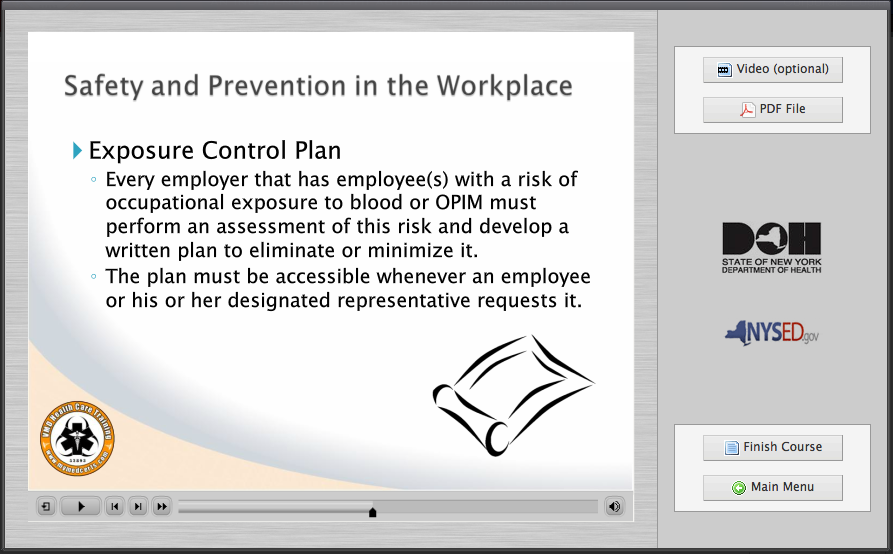
Course Sample 1
Course Sample 2
Optional Video Segment
Customer Reviews
Aleksey G.: (NJ)
10/31/2012
A simple approach to certification. Easy to browse menu and a no hassle process of payment and ability to print certification.
Catherine B.: (NY)
6/7/2012
Thank goodness for sites like this. It made re certifying so much easier! Thank you!
Dr. Mark F.: (NY)
1/2/2012
Thank you so much for offering a very thorough and enjoyable way to learn. Good job!!
Agnes G.: (NY)
12/24/2011
Fantastic course and the best price around. Thank you very much mymedcerts.com!
Ann M. M.: (NY)
12/24/2011
Thank you for ease of use program! Straight forward. Not designed for failure!!! Very educational presentation. Thank you.
Dr. Gerald H.: (NY)
11/14/2011
I previously took your infectious disease course and was most satisfied.
A.J.: (NJ)
9/13/2011
Your company is very convenient and I like your service and prompt response, thank you.
Roberta R.: (NY)
8/1/2011
Very informative.
K.P.M.: (NJ)
5/21/2011
Great course. Thanks.
Rachel B.: (PA)
3/15/2011
I have been so busy that i cant stay somewhere for a whole day so, this is amazing.
R.R.: (NJ)
11/4/2010
Thank you for making this so available. Sincerely, R. R.
C.M.: (NY)
11/4/2010
I really enjoyed what your website had to offer. Thanks again.
.....
Group Rates
Organizations needing group accounts are eligible for our great discount rates: