
Mobile Web App FAQs Corporate Login User Login
MyMedCerts Logo

Infection Control Training

Dually-Approved by New York State!

  • NYSDOH — New York State Department of Health
  • NYSED — New York State Education Department
  • For all Health Care Professionals
  • 4-year Certificate
NYS Infection Control Certificate

NYS Infection Control Training — Only $17.99

Register Now →

Diverse

Mandated training designed for all dentists, dental hygienists, licensed practical nurses, optometrists, podiatrists, registered nurses, physicians, residents, physician assistants, specialist assistants, medical students, PA students, and nursing students in the State of New York.

Approved

Approved by the New York State Department of Health (Provider #TP10694) for all professions.

Approved by the New York State Education Department (Provider #IC161) for all professions.

Valid for all health care professionals in New York State.

Quick & Convenient

Covers the full NYSDOH infection control curriculum. Many students finish in under two hours, but course work does not need to be completed in a single session. You may log off at any time and return to the online course and quiz whenever you like.

A downloadable PDF version of the course presentation for your mobile device is included.

Accessible

30-day access to course materials and quiz, and unlimited access to your certificate thereafter.

Awards a New York State Infection Control and Barrier Precautions certificate valid for 4 years, available for immediate download / printing plus 24/7 access to your certificate for its entire validity.

Course Curriculum

Six core elements of the NYSDOH infection control curriculum:

Element I
- Recognize the benefit to patients and healthcare workers of adhering to scientifically accepted principles and practices of infection prevention and control - Recognize the professional's responsibility to adhere to scientifically accepted infection prevention and control practices in all healthcare settings and the consequences of failing to comply - Recognize the professional's responsibility to monitor infection prevention and control practices of those medical and ancillary personnel for whom he or she is responsible
Element II
- Describe how pathogenic organisms are spread in healthcare settings - Identify the factors which influence the outcome of an exposure to pathogenic organisms in healthcare settings - List strategies for preventing transmission of pathogenic organisms - Describe how infection control concepts are applied in professional practice
Element III
- Define healthcare-associated disease transmission, engineering controls, safe injection practices, and work practice controls - Describe specific high-risk practices and procedures that increase the opportunity for healthcare worker and patient exposure to potentially infectious material - Describe specific measures to prevent transmission of bloodborne pathogens via contaminated injection equipment - Identify work practice controls designed to eliminate the transmission of bloodborne pathogens during use of sharp instruments - Identify where engineering or work practice controls can be utilized to prevent patient exposure to bloodborne pathogens
Element IV
- Describe the circumstances that require the use of barriers and personal protective equipment to prevent patient or healthcare worker contact with potentially infectious material - Identify specific barriers or personal protective equipment for patient and healthcare worker protection
Element V
- Define cleaning, disinfection, and sterilization - Differentiate between non-critical, semi-critical, and critical medical devices - Describe the three levels of disinfection (low, intermediate, and high) - Recognize the importance of the correct application of reprocessing methods for assuring the safety and integrity of patient care equipment - Recognize strategies for effective and appropriate pre-cleaning, chemical disinfection, and sterilization of instruments aimed at preventing transmission of bloodborne pathogens
Element VI
- Recognize the role of occupational health strategies in protecting healthcare workers and patients - Recognize non-specific disease findings that should prompt evaluation of healthcare workers - Identify occupational health strategies for preventing transmission of bloodborne pathogens and other communicable diseases - Identify resources for evaluation of healthcare workers infected with HIV, HBV, and/or HCV
Element VII
- Describe the scope of the sepsis problem and the NYS Sepsis Improvement Initiative - Recognize the signs and symptoms of sepsis to identify and treat at-risk patients, both adult and pediatric, as early as possible - Understand the need for rapid evaluation and management in adults and children if sepsis is suspected - Identify common sources of sepsis - Educate patients and families on methods for preventing infections and illnesses that can lead to sepsis

What You Can Expect

Screen Shots

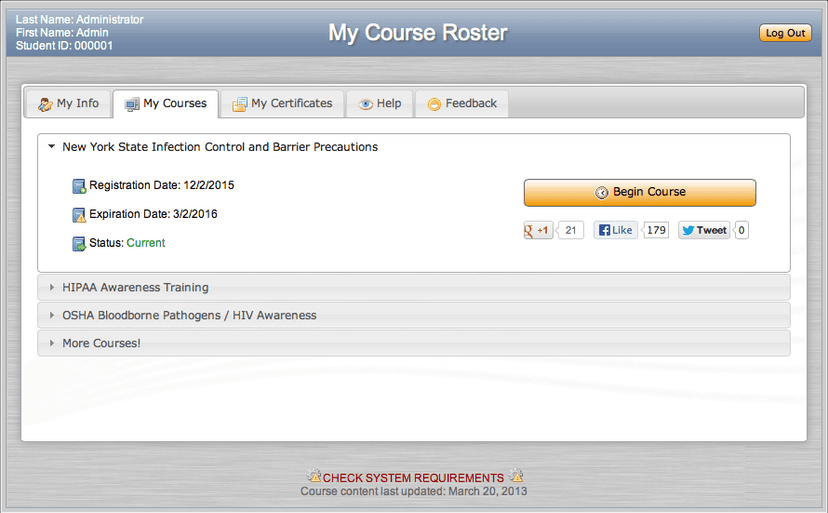
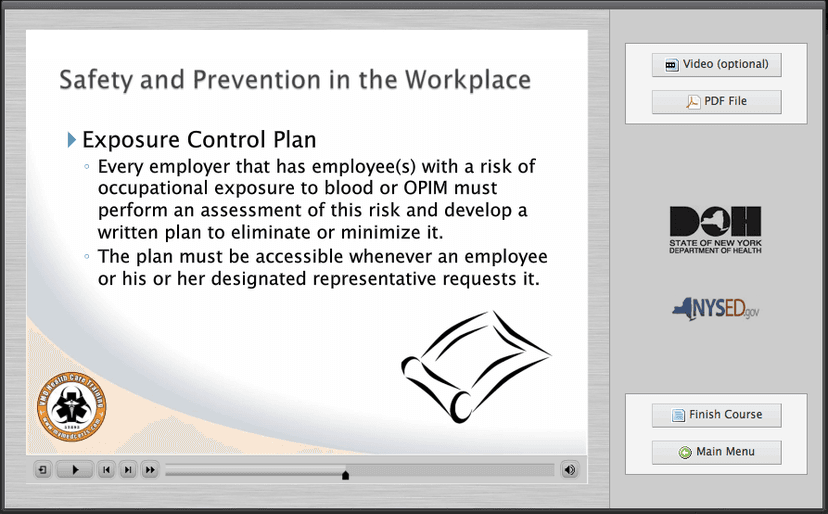
Our courses utilize the latest web technologies available on all modern HTML5-compliant browsers, to provide the most convenient learning experience possible.
Course Management
Course Management
Certificate Management
Presentation Screen
Presentation Screen
Desktop or Mobile
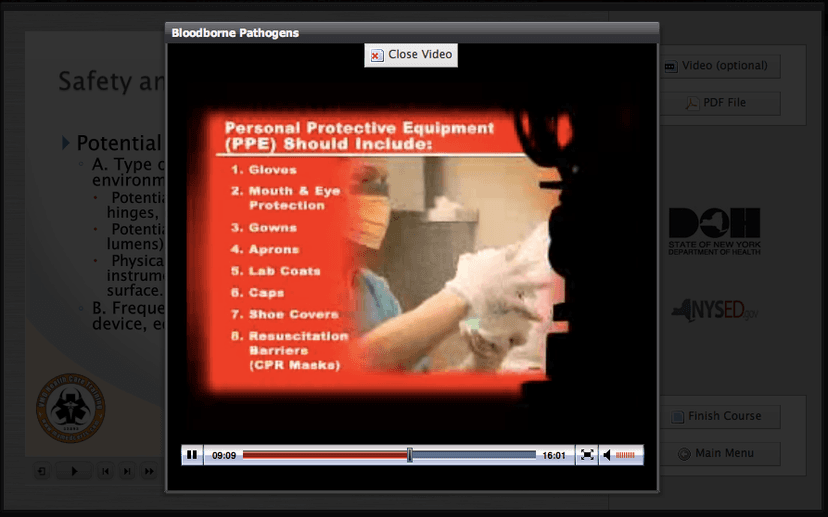
Video Screen
Video Screen
Optional and Free
Healthcare professional

Covered Professions

Who Should Take This Course

In compliance with New York State Law: all dentists, dental hygienists, licensed practical nurses, optometrists, podiatrists, and registered nurses must complete course work or training appropriate to their practice regarding infection control and barrier precautions every four years according to Section 6505-b of the Education Law. This training must be conducted by a provider approved by NYSED. VMD Health Care Training is an approved provider: #IC161 (verify here).

All physicians, physician assistants, and specialist assistants must complete course work in accordance with Chapter 786 of the Laws of 1992. This rule also applies to residents, medical students, and physician assistant students. This training must be conducted by a provider approved by NYSDOH. VMD Health Care Training is an approved provider: #TP10694 (verify here).

Certificate of Completion

How To Use Your Certificate

Dentists, Dental Hygienists, LPNs, Optometrists, Podiatrists, and RNs

NYSED Regulations
There is no need to mail the certificate to the State Education Department unless specifically instructed otherwise. Keep the certificate in the event that you are required to submit it at a later date.

You must simply attest to having completed this requirement to the State Education Department on your first licensure/registration application and at every subsequent registration.

Physicians, Residents, Physician Assistants, and Specialist Assistants

NYSDOH Regulations
If affiliated with a hospital, do not mail the certificate to the Department of Health. Keep the certificate and file a copy with your hospital HR / personnel office.

If not affiliated with a hospital, you must mail the certificate to the Department of Health. Please also keep a copy for your records.

Students: medical, physician assistant, and nursing

School Regulations
If affiliated with your college or university, you do not need to mail the certificate to DOH or SED. Instead, submit a copy of the certificate directly to your school's appropriate department.

If your school participates as one of our clients, you may have the option of auto-submitting your certificate to your school's designated contact directly from your course page.

What Our Learners Have Said

A Few Words From Our Satisfied Customers

CariAnne
I was very pleased with the course. It was easy to follow and not too expensive. It was so convenient to do the course on-line.

CariAnne

New York
Elizabeth Guillaume, RN
Fantastic site, easy to use and simple to navigate. It was a well organized and clear video and gave me all the information I needed. Thank you for the experience!

Elizabeth Guillaume, RN

Georgia
  • Client logo 1
  • Client logo 2
  • Client logo 3
  • Client logo 4
  • Client logo 5
  • Client logo 6

Instant access to course, quiz, and certificate — Let's Get Started

Only $17.99. Register Today!